What Is a Decision Model? How Jev Works and How It Differs from an LLM
A specialized decision model is a neural network that doesn't write text. Instead, it picks an answer from options the developer defines and reports how confident it is. Ask it "Which department should handle this ticket: billing, tech support or sales?" and you won't get a paragraph back. You'll get the value "tech support" plus a probability for every option. The software can use that answer in code right away.
The first decision model released as a public product was Jev from TypeSafe AI. It launched in early access on September 15, 2026. The company calls this class of AI "System One Models", while the press and research papers have settled on "decision models". "System One" refers to Daniel Kahneman's book on fast and slow thinking, and Jev itself is named after the economist William Stanley Jevons, who noticed that making a resource cheaper increases how much of it gets used.
LLMs generate text token by token, while models like Jev return a finished decision in a single pass. They don't replace ChatGPT or Claude. They work inside software: routing requests, moderating content and checking the output of other models.
How Does a Specialized Decision Model Work?
A decision model has a fixed set of possible answers: it reads natural-language text but replies only with options from a list. "Specialized" refers to the format of the answer, not the subject. The same Jev model can assess a customer complaint, a contract or a move in a game.
Here's an example. An online store needs to sort support tickets into five categories. A rule like "if the message contains 'refund', file it under Returns" will fail on "Please refund the duplicate charge", which is actually a billing issue. An LLM will understand the meaning, but it takes a few seconds to answer and sometimes adds extra words. A decision model also understands the meaning, but it answers with exactly one of the five options, in a fraction of a second.
Why is it faster? A language model spends most of its time on sequential generation: each new token depends on the previous one, so they can't be computed at the same time. If the LLM reasons before answering, the count grows to hundreds or thousands of tokens. A decision model needs only one pass over the input. According to TypeSafe, Jev computes all answers in parallel within a single request. Its documentation gives an example: 13 questions in one call cost 11.5 times less and ran 9.6 times faster than 13 separate calls, with the same answers.
A request to Jev consists of a state (text or JSON) and a set of questions. There are three question types: Choice picks one of several options, Score places the input on a scale, and Noul gives the probability that the answer is "yes". The model answers every question in a request in parallel, so an extra question barely slows it down.
Jev is trained with RLCD, short for Reinforcement Learning for Calibrated Decisions. The goal is for a model that says it's 90% sure to be right about 9 times out of 10. That lets software act on confident decisions automatically and hand doubtful ones to a person. TypeSafe doesn't disclose Jev's size or base model, and the model is available only through a cloud API.
Under the hood, it's still a transformer, the same architecture LLMs are built on. The model reads the input and builds an internal representation of it. The difference is in the last step. After reading, an LLM starts predicting the next token, then another, until the answer is complete. A decision model instead scores the allowed options right away and outputs a probability distribution over them.
Decision Model vs. LLM: What's the Difference?
An LLM generates free-form text one token at a time, while a decision model chooses from a set of options in a single pass. That leads to differences in price, speed and how reliable the output format is.
• Speed. According to TypeSafe, Jev responds in 70–500 milliseconds, while frontier LLMs take 3–329 seconds.
• Price. Jev costs $0.042 per million input tokens, and output tokens are free. LLM input costs $0.20–10 per million tokens.
• Format. Jev can't return an option that isn't on the list, or broken JSON.
• Confidence. Every answer comes with probabilities. On the JEVal benchmark, Jev's calibration error was 0.053, compared with 0.116 for the most accurate LLM tested.
Independent research backs up the vendor's numbers. A study that used different models as "judges" scoring answers against a rubric found that LLMs cost 16–325 times more than Jev.
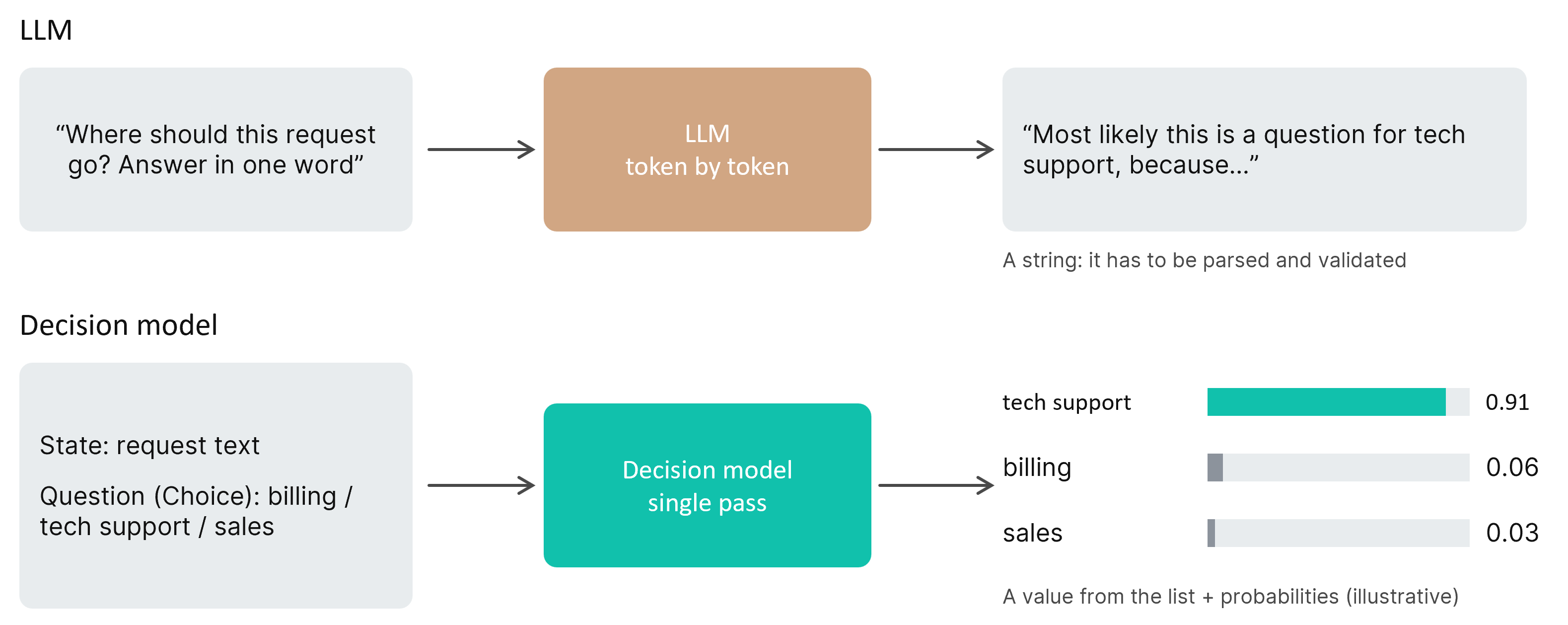
An LLM takes text and returns text; a decision model takes a state and questions and returns an option with probabilities.
Decision models have weak spots too. Researchers from Dalian showed that Jev matches frontier LLMs on knowledge tasks but falls well behind on math. On JEVal, Jev trailed LLMs in medicine, finance and law. The model guarantees the format of its answer, not that the answer is correct.
That's why these models are used alongside LLMs: the decision model routes and checks, while the LLM writes and reasons. This setup turns out to be highly versatile. For example, GPT-6 Astra paired with Jev beat Minecraft in just 8 minutes 43 seconds.
What Are the Alternatives to Jev?
The main alternatives to Jev are open models you can run on your own computer or server. Many of them are compatible with Jev's API. Here are a few examples:
• Kev: a family of Qwen-based models ranging from 0.8 to 27 billion parameters.
• Nimble from Bespoke Labs, with 9 billion parameters.
• Tev1 from Together AI: experimental models with 4 and 0.8 billion parameters.
• InnerJev from Fudan University, available in 4 and 27 billion parameter versions.
• Laya and Von: compact ModernBERT-based models with about 400 million parameters, for simple tasks.
There are proprietary models too, such as Microsoft-Decision-1 from Microsoft. Jev and models like it are sold as a cloud service where you pay by volume: Jev charges $0.042 per million input tokens. A million tokens cover several thousand short support tickets, so a single request costs a fraction of a cent. Open models such as Kev or Nimble are free to use, including commercially. But "free" here means "no subscription fee": you still have to run the model somewhere, which means paying for a computer or server and the electricity. A powerful laptop is enough for smaller models. A 27-billion-parameter model needs a server GPU, and that only pays off with a high volume of requests.
So, the choice usually depends less on the price of one request than on two things: how many decisions you need to make, and whether your data can leave the company. For a small project, a cloud model with pay-as-you-go pricing is simpler and cheaper. A bank or clinic that can't share customer data with an outside service is better off running an open model on its own hardware: the data stays in-house, and costs don't rise with every new request.
Conclusion: Are Decision Models Worth Watching?
To sum up, a decision model is like an experienced employee who sorts incoming mail into folders in a second but never writes a single reply. A language model like GPT or Claude is more like a conversation partner: it can discuss the letter, explain it and draft a response, but it takes noticeably more time and money to do so. Inside software, most of the questions put to AI are of the first kind: "yes or no?", "which of these three options?" Those don't need a conversation partner.
It's too early to say how far this technology will go. It's less than two months old, and the most impressive speed and price figures come from the developer itself. But there are two signs it's more than a passing trend. First, within weeks, enthusiasts and researchers released free alternatives. Some of them already match Jev's accuracy and run on an ordinary laptop. Second, the idea solves a real problem. When a decision costs a fraction of a cent and takes a fraction of a second, AI can take on thousands of small checks that used to be too expensive to automate.
The limitations are clear as well. These models make mistakes, sometimes confidently; they struggle with arithmetic; and in long chains of actions, their errors add up. So, decision models probably won't replace the chatbots we're used to. More likely, they'll become their invisible helpers, working under the hood of apps to sort, check and route, while language models do the talking.