What Are AI Agents and How Do They Differ from LLM-Based Chatbots
In 2026, AI agents are everywhere in the news. We regularly hear about another agent proving useful in a new area of human activity. For example, OpenAI announced that it had reached its goal of creating an automated research intern: a system capable of performing well-defined research tasks under human supervision — tasks that would otherwise take a specialist several days.
It may seem that only a couple of years ago everyone was talking about large language models (LLMs) — how capable they were and what a wonderful future awaited us. Two years is an instant compared with physics or biology, but almost an eternity by the standards of AI research. As a result, people unfamiliar with the field can easily confuse a chatbot, an agent, and a language model. To prevent that, let’s start with the basic concepts.
What Is a Language Model?
A language model is an algorithm that calculates the most probable continuation of a sequence of text. More precisely, a model predicts not words but tokens — fragments of text into which the system breaks the input string. By selecting tokens one after another, it forms a response to the user’s prompt.
In early language models, probabilistic relationships between tokens were specified manually. Today, this task is handled by machine-learning methods, the most powerful of which have turned out to be neural networks. During training, a model is first exposed to a large amount of human-written text, and the algorithm learns its regularities. At this stage, the neural network’s weights change — these are the numerical parameters in which the model’s ability to continue text is encoded. Neural-network models based on the transformer architecture have proved particularly effective.
Transformers made scaling possible: model quality grew along with the size of the neural network, the training dataset, and the available computing resources. As a result, models emerged that came to be called large language models. The formal boundary of one billion parameters is arbitrary: what matters more is not the number itself, but the capabilities a model acquires.
Examples of LLMs include OpenAI’s GPT family, Anthropic’s Claude, Google’s Gemini, Alibaba’s Qwen, and many others. New model versions bring not only larger sizes but also new capabilities, such as image recognition, audio processing, code generation, and step-by-step problem solving.
You may sometimes hear the phrase “ChatGPT is an LLM,” but it is not quite accurate. ChatGPT is an AI service with a user interface, usually presented as a chat. It provides access to one or more language models and supplements them with system instructions, conversation history, filters, and other components. Many services, including Perplexity and Gemini, work according to the same principle.
What Happens Inside an LLM?
An LLM is, despite its size, still a next-token predictor. The user submits a prompt, the model processes it and generates text token by token, then stops and waits for the next request.
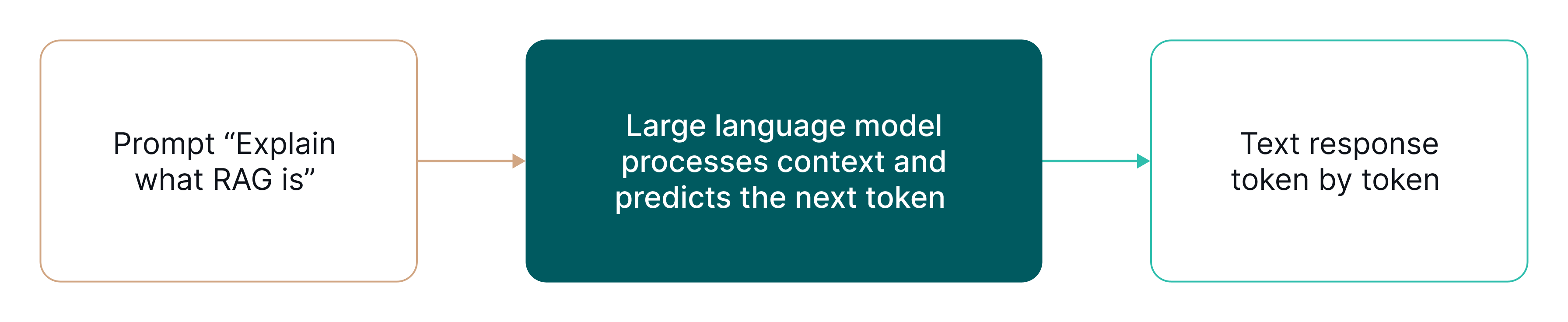
This does not mean that a language model is primitive. During prediction, it uses complex statistical representations that allow it to translate, summarize, write programs, and maintain a meaningful dialogue. However, the model itself usually does not perform actions in the outside world. If asked to send an email, it can draft a good message, but without a connection to an email service it cannot click the “Send” button.
An LLM primarily answers the question, “What text should come next?” An AI agent addresses a more complex question: “What actions should be performed to achieve the goal?”
What Is an AI Agent?
An AI agent is a system that receives a goal and autonomously selects actions to achieve it in a loop: it affects its environment, usually through external tools, observes the results, and uses them to determine the next step. An LLM often serves as the agent’s decision-making core, but what distinguishes an agent is the presence of a control loop, tools, memory, and constraints.
A so-called harness is built around the language model — a software layer that enables a long-running, closed-loop sequence of actions. The agent receives a task, proposes a step, calls a tool, receives a result, evaluates it, and decides what to do next. It is this “reasoning — action — observation” cycle that creates the impression of autonomy.
The boundary beyond which a system is called an agent is not clear-cut: agency is not a binary property, but rather a spectrum. It is useful to distinguish two poles. In a typical LLM workflow, the steps and transitions between them are specified in advance by the developer, while the model performs its part at each step. In an agent, the model itself controls the execution: it decides which tool to call, what to do with the result, and when the task is complete.
The key criterion is not the complexity of the system, but who determines its trajectory: the developer or the model. A workflow is more stable and predictable: because its trajectory is defined in advance, failures are easier to isolate and debugging is considerably simpler. But not every scenario fits rigid logic. If the order of steps depends on what is discovered along the way, an agent is needed.
In practice, most systems lie somewhere between these poles. ChatGPT itself is, in fact, already an AI agent with a chat interface. The underlying LLM cannot search the internet “out of the box,” while ChatGPT hides this capability behind its chat interface.
Planning, Memory, and Tools
The components of an agentic system vary depending on its task, but most often they include a planner, memory, and tools.
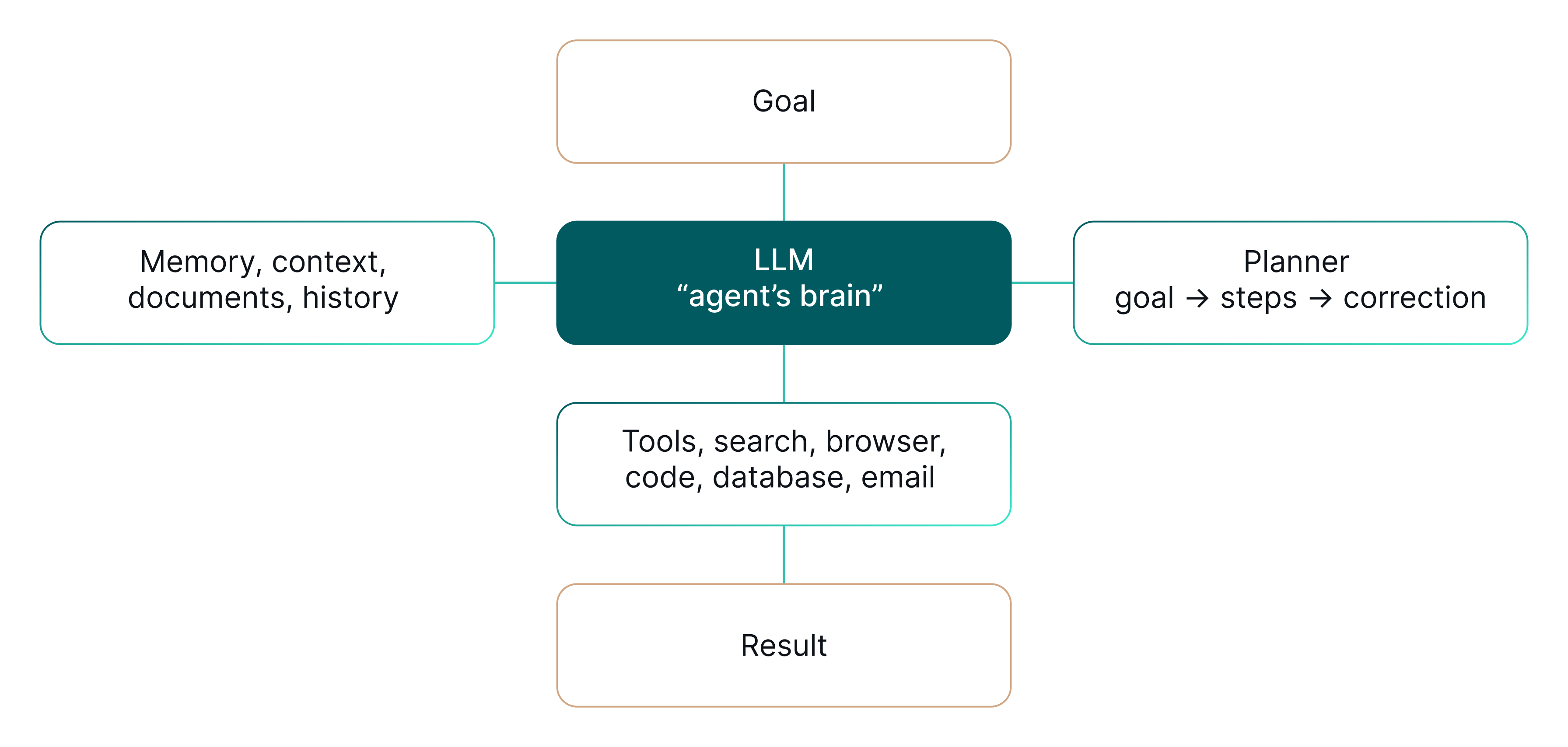
An AI agent combines a language model, memory, planning, and access to tools
Planning
A planner breaks down the overall goal into a sequence of steps, chooses a strategy, and changes the plan if something goes wrong. For example, if an agent has to prepare an overview of a scientific topic, it can first find papers, then select the most relevant ones, extract data from them, and only then write the text.
One common approach is ReAct. The agent alternates between choosing a step and taking an action: it requests data, observes the result, refines its hypothesis, and calls the next tool. An alternative is Plan-and-execute: the system first builds an overall plan and then executes it step by step. In practice, hybrid schemes are common: a powerful model creates a high-level plan, while a small ReAct loop operates inside each item.
Memory
A large language model does not have memory in the usual sense. Everything it learned during training is encoded in its weights, which do not change from one request to another. Agent memory is therefore a property of the system surrounding the model, and it is useful to distinguish two levels.
Short-term memory is the context window: the dialogue history, the results of tool calls, and intermediate conclusions for the current task. The model “remembers” only what is passed to it in the current request. This memory is limited by the context-window size and exists within a single session: when the task ends or the context overflows, its contents are lost.
Long-term memory is external storage that persists between sessions: documents, the results of previous actions, user preferences, and important facts. The model does not see it directly; relevant information is retrieved and inserted into the context. In other words, long-term memory works only through short-term memory. Recent research describes this process as a “write — organize — read” cycle connected to the system’s perception and actions.
Tools
Tools connect an agent to the outside world. They can include a search engine, browser, calculator, code interpreter, database, calendar, email service, or another service’s API. The model selects a tool and formulates a request, while the software layer returns the result to the context.
For example, an ordinary LLM can explain how a telescope works. An agent can additionally find recent publications, check dates, compare instrument specifications, and enter the information into a table. This does not eliminate the need for human review: an agent may choose an unsuitable source, misinterpret the data, or confidently continue after making an error.
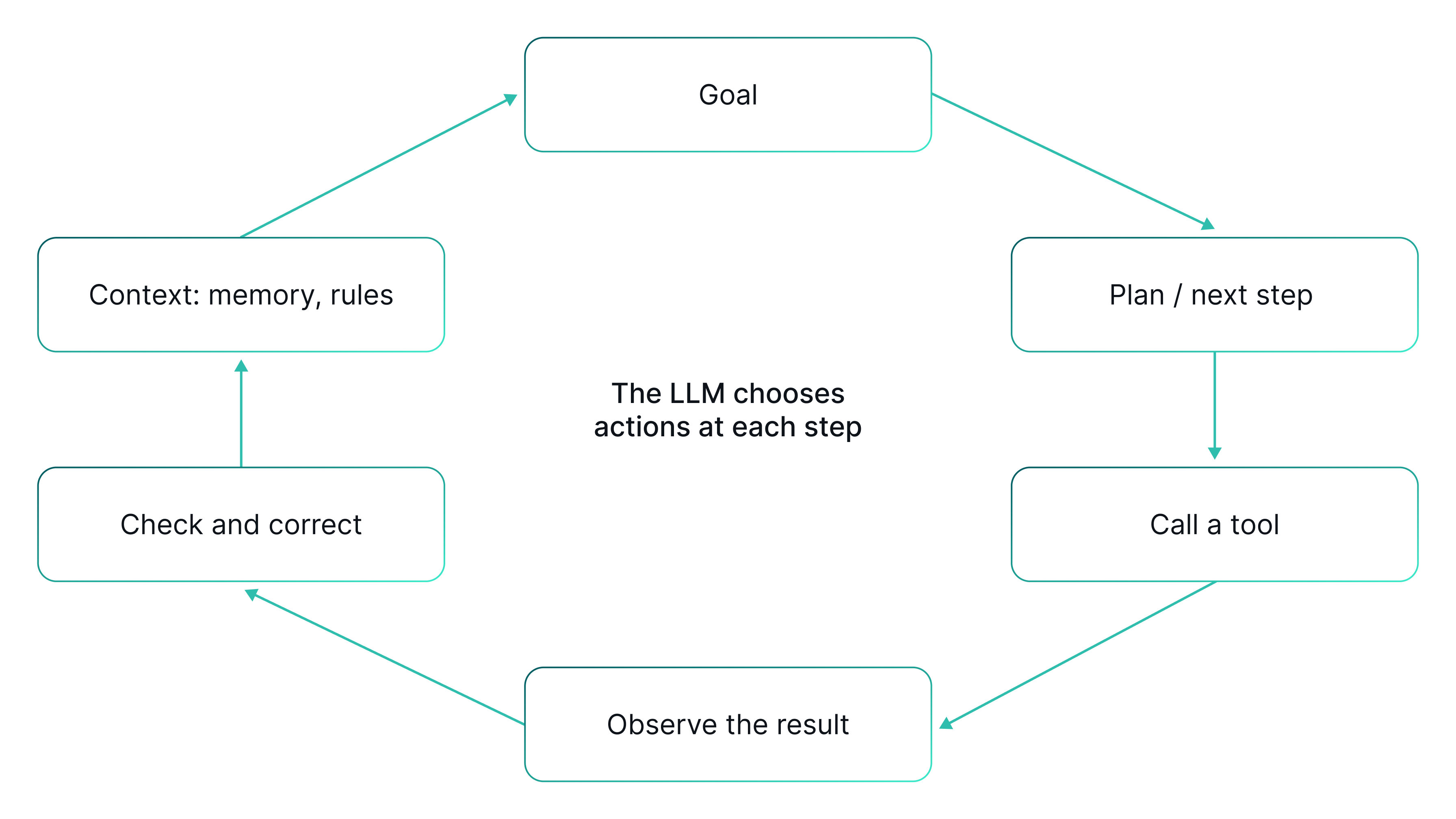
An agent adjusts its next actions based on the result of the previous step
How Is an Agent Different from a Chatbot?
A classic chatbot waits for a user message and responds to it: question — answer, then another question — another answer. Each step taken by the model is initiated by a human.
An agent receives a more general goal and can independently perform several steps between the initial task and the final result: request information, run code, access databases, revise its plan, and report limitations.
At the same time, “chatbot” and “agent” are not two classes of product, but two different characteristics. The first describes the interface — a dialogue with the user — while the second describes how the system operates between requests and answers. Modern assistants such as ChatGPT therefore combine both properties: they provide a chat interface while an agent operates behind it. Given a question, the system can call a search tool several times, run code, consult memory, and only then respond. Pure chatbots — models that only respond to text with text — have almost disappeared from mainstream products.
The distinction can be summarized briefly:
- LLM generates text based on context.
- Chatbot provides a convenient interface for interacting with a model and additional services.
- AI agent uses a model, tools, memory, and a feedback loop to achieve a goal.
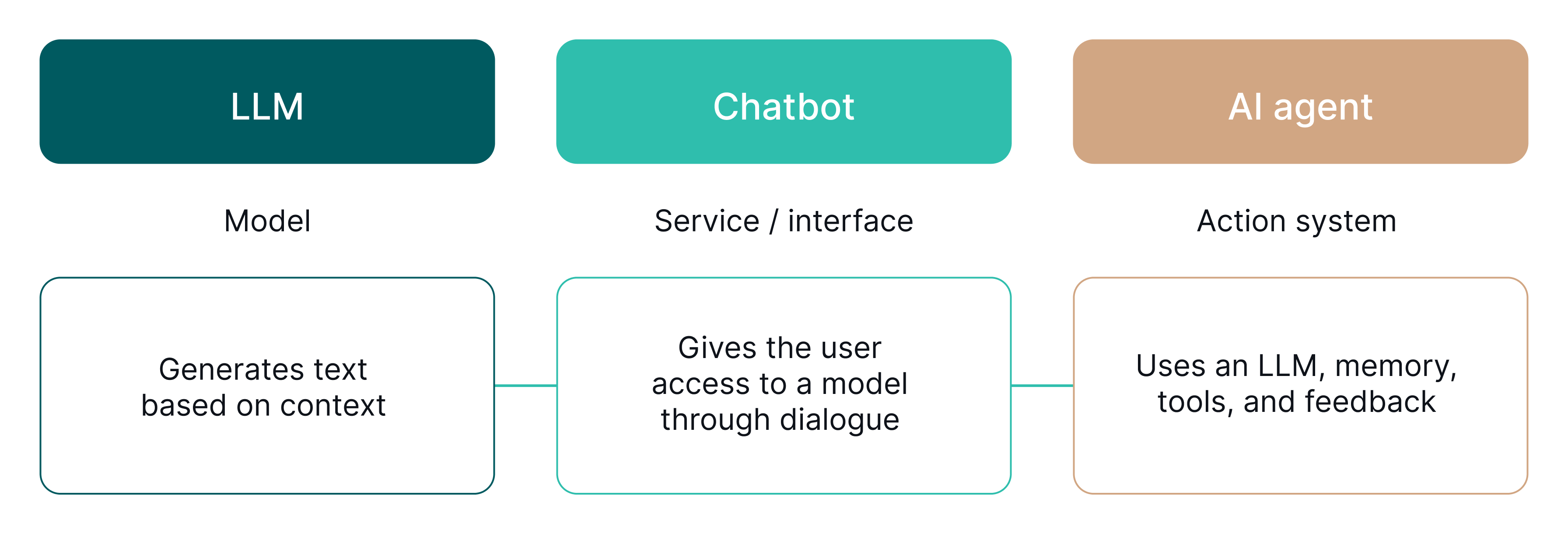
A model generates text, a chatbot provides an interface, and an agent uses tools to complete a task
However, an agentic mode is not always necessary. If the task requires a short answer or a single text transformation, a multistep loop will only add latency, cost, and new sources of error. It is useful when a task consists of several steps, requires external data, and allows the plan to change along the way. Modern assistants make this choice themselves: they answer a simple question immediately and launch a tool-using loop for a complex one.
Limitations of AI Agents
An agentic harness does not turn a language model into an infallible expert. A model may suggest the wrong step, misunderstand a tool’s output, or mistake a plausible claim for a fact. The more actions an agent is allowed to take, the more serious the consequences of an error can be.
That is why real-world systems restrict access to tools, set a step limit, log actions, and require human confirmation before sending emails, deleting files, publishing materials, or performing financial operations. An agent must not only be able to act, but also to stop when a task is ambiguous or its result cannot be reliably verified.
Conclusion
An AI agent is not a special type of neural network, nor necessarily an autonomous digital personality. It is a software architecture in which a language model receives a goal, tools, memory, and the ability to act in a feedback loop.
An LLM can be regarded as the intellectual core, while an agent is a complete system that connects this core to the external environment. A good chatbot simply answers questions, whereas an agent can determine which steps are needed to solve a task. But autonomy does not equal reliability: the more complex the agent, the more important it is to verify its actions and define clear boundaries of responsibility.